
“More Music Education” might be an excellent headline, but it’s a terrible implementation plan.
I’m tired of music education being lumped together in one pile — by talking about it as though it is one thing, we’re failing to address the actual problems.
Because “music education” is an umbrella term, we are diagnosing different problems as though they are the same problem, simply because they all sit underneath. Curriculum access, instrumental tuition, school ensembles, tertiary pathways and the professional talent pipeline are connected, but they are not the same thing. They don’t require the same solutions, and they certainly don’t require the same infrastructure.
Forgive me - I’m going to use a sports analogy. I know it’s a bit of a Trojan horse, but it helps paint the picture.
Music education is any situation where someone is furthering their education in music. That can mean an early childhood music playgroup, a 4th grade classroom lesson, learning the trumpet, playing in a school orchestra or studying a Doctorate of Music. It’s all music education, in the same way that kicking a soccer ball with your child at the park and representing your country at the World Cup are both soccer.
But we would never pretend those things require the same infrastructure, funding or policy.
Music in Schools
At its simplest, music education in Australian schools has a few distinct layers. The first is curriculum music. This is the music every student is supposed to learn at school, taught by either a generalist or specialist teacher. It is practical skills and theoretical knowledge, with outcomes stipulated by the syllabus and achievement standards. It is for everyone, whether you love music, hate it, are brilliant at it or cannot clap in time to save yourself.
Now, the sporting equivalent isn’t actually school sport. It’s Personal Development, Health and Physical Education (PDHPE). You learn physical skills, but you also learn about health and wellbeing. Everyone does it because we’ve collectively decided there is value in every child having that knowledge and experience.
In most systems, compulsory arts education runs from Kindergarten to Year 8, after which music becomes an elective. Subjects like PDHPE, Science and Humanities (HSIE) remain compulsory until Year 10. The arts bow out earlier. Apparently, at age 14 students have absorbed enough knowledge of the arts to see themselves through.
Under the new Australian Curriculum, schools are required to provide learning in each Arts discipline (music, dance, drama, visual art, media arts) across a band of years rather than necessarily every year, creating significant gaps between a child’s experiences of classroom music. For my US colleagues, the structure varies enormously by state and district, but the distinction I’m making is the same.
Learning an Instrument
Then there is learning an instrument, and this is where things start getting muddled.
For many children, learning an instrument is a choice. Their parents pay for tuition outside school, or they might access a peripatetic instrumental teacher on school grounds. Conservatoriums and other organisations also provide tuition, often feeding students into bands, ensembles and orchestras. The Music Teachers’ Association of NSW recommended rate for an accredited teacher is $126.50 an hour.
The sporting equivalent is choosing to play soccer. You join a club, train during the week and play on weekends. Your parents pay the registration fees, uniform, equipment and everything else that comes with it.
Instrumental tuition has historically been one-to-one. Most children’s sport is delivered one-to-many: teams, squads and group training. That difference alone fundamentally makes the economics more challenging.
Co-Curricular Instrument Programs
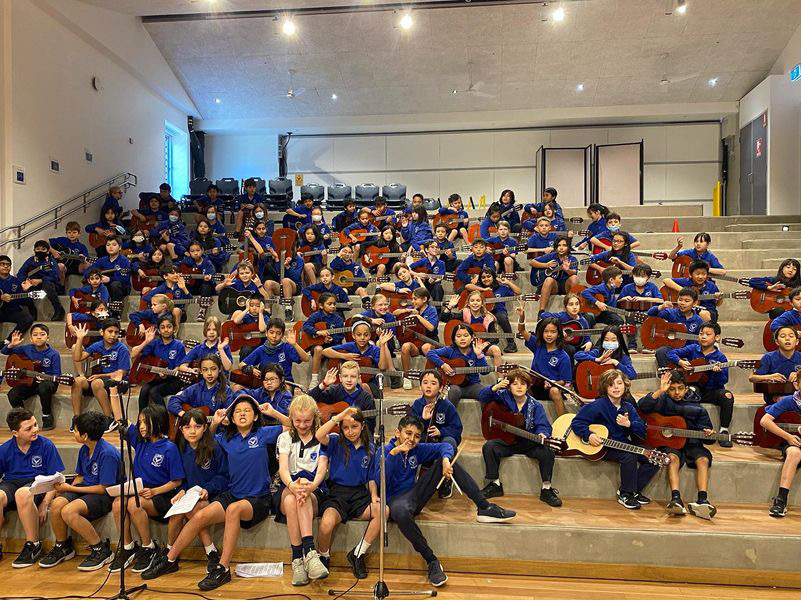
Some schools take a different approach and offer compulsory co-curricular instrumental programs. These are most common in the independent or private sector, although Sydney Catholic Schools has attracted attention recently with its Amadeus Program. Parents may still be required to contribute financially, but the program is generally subsidised by the school or system. The sporting equivalent is compulsory school sport, which is similarly funded or subsidised through the school.
There is an incredibly important distinction here: instrumental programs do not replace curriculum music, in exactly the same way that playing Saturday soccer doesn’t replace PDHPE. They serve different purposes.
The Talent Pipeline
A recent ABC article discussing the NSW live music inquiry reported concerns that a lack of music education in regional areas is affecting the pipeline of future musicians. But much of what was actually being discussed was a lack of access to instrumental tuition. That distinction matters because, regardless of where a student lives, they should (should) already be receiving curriculum music at school. The problem being described was that far fewer children have equitable access to the next layer.
And as a parent of two primary-aged children, I understand why. It’s expensive! Instrumental tuition has traditionally been built around a one-to-one model: one highly skilled teacher and one student. Add the cost of an instrument, travel and the logistical nightmare of getting children to lessons in a two-working-parent household and the barriers stack up quickly. At some point children also need to practice, and that’s not exactly effortless.
The Complexity is Real
Schools can’t simply be blamed for that. Running a robust instrumental program is not a light lift. It requires teachers, instruments, rooms, scheduling, administration and, crucially, enough families willing and able to pay for it. And while this may not be popular: a school’s core job is to deliver the curriculum. Instrumental tuition is not the curriculum. If parent demand isn’t there because the cost is prohibitive, schools are left trying to sustain an expensive program without the economics to support it.
Fixing it isn’t as simple as saying we need “more music education.” More curriculum music? More instrumental tuition? More performance opportunities? More specialist teachers? More instruments? More tertiary pathways? More skilled industry workers? “More Music Education” might be an excellent headline, but it’s a terrible implementation plan. Each of those is a different problem requiring a different solution.
And this isn’t just an Australian problem. The UK recently released Turn It Up: Our Plan for Music, a national policy that puts education firmly on the agenda. For context, there are roughly 4.7 million primary-aged students in the UK.
On the surface, there is a lot to like. Curriculum reform is great and much needed. Music Hubs supporting schools with equipment, technology and expertise have a track record mostly of success. The creation of the National Centre for Arts and Music Education hopefully equals accountability. And, targeted support for Special Educational Needs and Disabilities (SEND) schools? YES! These kids need music.
But when you look at the scale of the system, you begin to see the challenge. £25 million for around 130,000 instruments sounds enormous until you put it beside millions of children. A four-year pilot supporting music provision in SEND settings is valuable, but only reaches around 1,000 students. And Music Hubs are being asked to support both curriculum delivery and extracurricular enrichment, which are fundamentally different jobs requiring different infrastructure.
None of this makes the policy bad. But layer it with the reality that the UK Department of Education has missed its Music Teacher recruitment goals in 12 of the last 13 years and currently there are less music teachers in schools than ever before — the policy isn’t really hitting where it needs to.
This demonstrates how enormous and complicated the problem is, and how quickly significant investment can barely touch the sides when we are trying to solve multiple problems simultaneously.
Because music education isn’t one system. It is an ecosystem. Curriculum creates universal access and foundational knowledge. Instrumental tuition develops technical skill. Ensembles and bands create opportunities to perform with others. Tertiary institutions develop advanced expertise. The professional industry sits further downstream. They connect to each other, but they are not interchangeable.
If we want more children learning instruments, more regional musicians, stronger ensembles, better pathways and ultimately a healthier music industry, I’m completely on board. But we need to stop diagnosing different problems as though they are the same simply because they all carry the label of “music education.”
If we don’t accurately define which music education problem we’re trying to solve, we’ll keep spending money on solutions that barely touch it.
And please, stop blaming the schools.